10 free online marketing tools that every “hands-on” marketer should use
The best tools for understanding your online marketplace?
-
1. Reviewing the latest developments in your industry
There still isn’t a better alternative than Google Alerts for reviewing mentions of your brand name, competitor or sector names by entering keywords, so it’s widely used.
Although RSS isn’t “in vogue” as it was 5+ years ago, I still find
there’s no substitute for using this as a listening post for
developments in your industry. When I wrote the previous post I used Google Reader
to categorise sites to keep up-to-date with the latest developments in
digital. When Google withdrew this since there was no revenue in it
(Boo!) I used Reeder as an offline client on my Macbook Air and iOS for a while. But now I recommend Feedly since
it's the most popular so you can see by the 'voice of the crowd' which
posts are most popular. Similar to the feature in PostRank that Google
also killed off. Although feed readers aren't in fashion they are the
most efficient way to scan the latest news in different categories. So
if you don't use them try Feedly out - our analytics shows it's one of
the most common referrers to Smart Insights - do bookmark us!

-
2. Managing social media updates
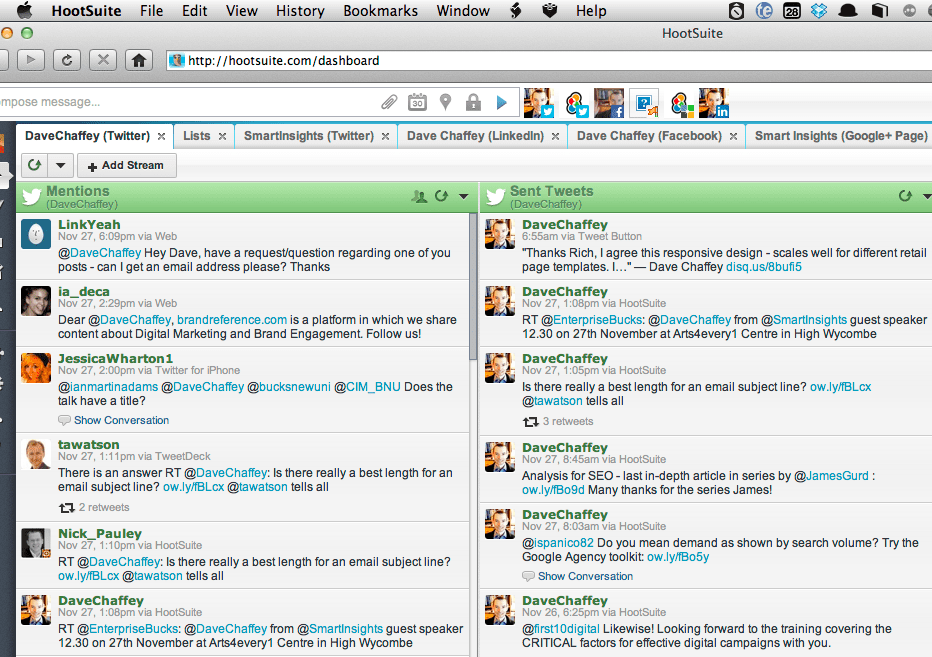
I’ve used Hootsuite for posting updates to social networks and reviewing what others are saying for nearly five years now after using Tweetdeck back
in the day - Twitter killed that one off for general
use. Hootsuite seems to be comfortably the most popular free tool for
posting and reviewing social media updates, but many still don’t know
it, it can be used as a personal social media management tool too. It
enables you to quickly post to all the main social networks including
Google+ company pages and review conversations and messages. I’ve
trialled many paid tools, but none come close. The paid version is
worthwhile IMO for adding campaign tracking and extra reports.
-
3. Finding influencers
There is no single free tool that works well for this - please suggest alternatives. You can use reputation tools like Klout, Kred or Peerindex, but I find that the use of Twitter autofollow means that this often skews the results.

LinkedIn sector skills used
to be the best source for finding business influencers because of
grouping by narrower topics - but LinkedIn killed this - monetisation
again. LinkedIn advanced search is probably the best replacement.

I'm interested to know alternatives readers use here - please share in the comments or on social!
-
4. Understanding customer search behaviour
With search still driving the majority of visits, leads and sales for
most businesses online, I believe that even marketers who outsource
their SEO need to understand different types of customer behaviour when
searching to help develop strategies for getting visibility AND creating
content and messages to help meet consumer needs.
When I first wrote this post I recommended the Google Keyword Tool, but now it's been renamed to the Google Keyword Planner, but is still an indispensable tool alongside the Google Webmaster Tools integration now that The Growth of Not Provided keywords means we can't use analytics reliably to find referring keywords. The Google Keyword Planner (tutorial)
is still indispensable for this - I don’t think I have ever done a
client training or consulting project where I haven’t used it! It's
harder to get to now it's integrated into Google AdWords, but it's still
free if you don't invest in AdWords.

Google Insights for search has now been folded into Google Trends essential for understanding seasonal search behaviour trends in different countries.
Ubersuggest
is also useful for summarising the Suggest/Autocomplete behaviour in
different countries to check your covering the main behaviours.

As I was researching this post for 2015 I noticed a new 'Tool on the Block' for keyword analysis - check out KeywordTool.io.
It's like UberSuggest, but with better formatting - I often use this to
show how local consumer behaviour differs, for example I was giving a
training workshop to a Shredders manufacturer - quite a different term
en France par example:

-
5. Competitor site benchmarking
It used to be that Google AdPlanner was unbeatable for comparing
audience size and dimension. That's been folded into AdWords as the
Campaign Planner and now limited to media sites, but still useful for
finding size and quality of audience for partner and media sites and
don't forget about the related Google Placement Targeting Tool useful
for remarketing and research.
Today, my 'go to' tool for benchmarking is Similar Web, a freemium tool launched in 2013 and offering free stats on all sites including referrers. Here's how Smart Insights looks:

Chris Soames has a another post here on the main sites for competitor benchmarking.
You will probably have to fall back on Alexa or Compete today which
don’t tend to give realistic estimates outside of the US. I have also
have an in-depth post recommending many other online competitor benchmarking tools.
-
6. Off-page backlink analysis for SEO
Lots of tools in this category, see our comparison of 6 best backlink analysis tools.
Of these, Majestic and Moz Open Site Explorer have to be the “must
use” tools. I think for non-SEOs, the Backlink History is great for
basic benchmarking of competitor success in gaining backlinks although
link quality isn’t shown.

-
7. On-page markup analysis for SEO
Hubspots Site, now Marketing Grader for reviewing on-page for SEO is often mentioned as a useful tool by people on courses.
For reviewing on-page markup like headings and also mobile screen resizing I find Chris Pederick's Web Developer Toolbar
for Chrome and Firefox essential. The Moz Toolbar is better from an SEO
POV. Here's an example of the overlay to show our 'semantic markup':

-
8. Understanding overall online marketing effectiveness
I believe that Google Analytics or an equivalent is essential for all who work in marketing to master at some level.
To help here, we have many articles of advice you can access from our Google Analytics hub. The most popular is on using Google Analytics for social media marketing.

If you know all these tools, try the Google Agency Toolkit where they group all their tools together.
Looking for a more comprehensive range of tools? See this excellent
directory from Razor Social collated by Ian Cleary for a bigger
selection of online marketing tools and services where you can select by category.
I hope this compilation is useful, what do you find most useful of
the digital marketing tools we have covered here and other tools we
don't?

Comments
Post a Comment